
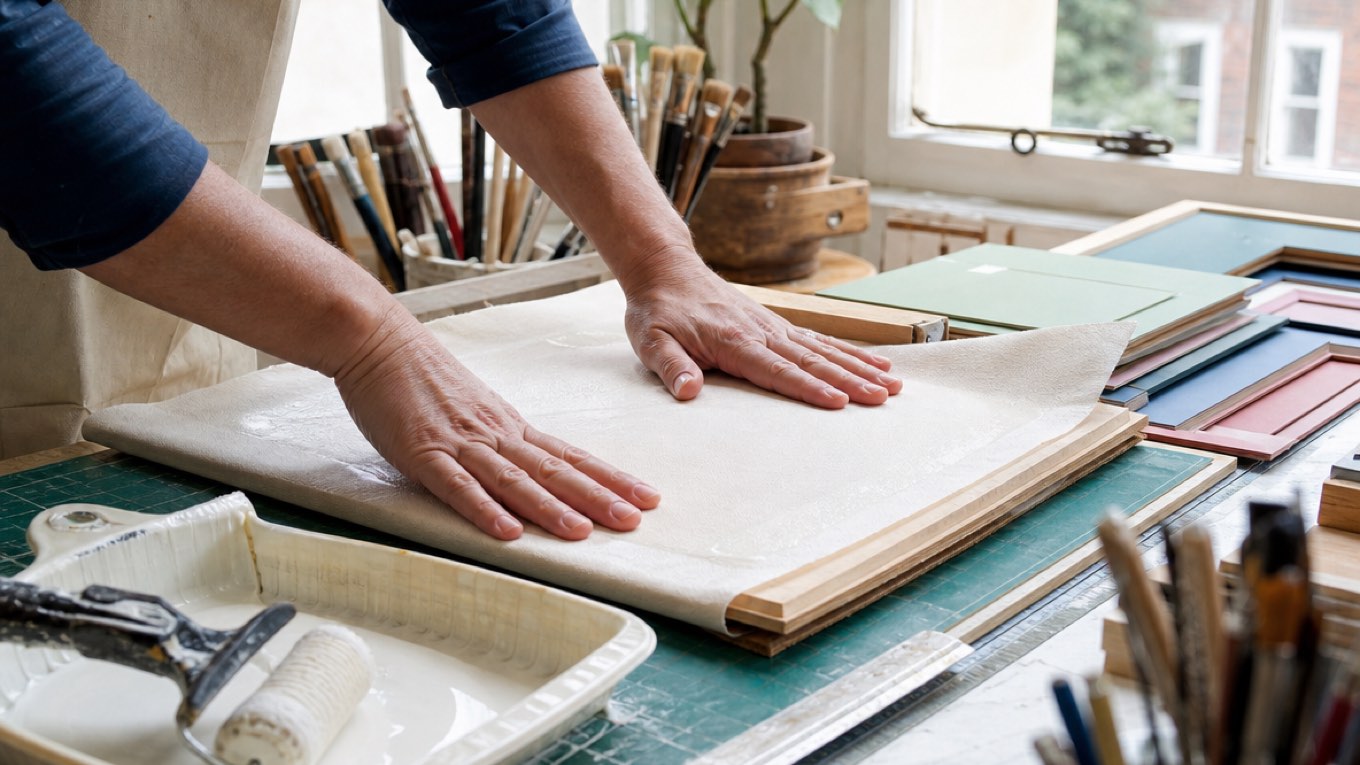
The wet mount
Miracle Muck is a modified PVA adhesive, a water-based glue in the same family as ordinary wood glue, formulated here for textile-to-panel work. Apply it cold and wet, straight from the jug. Roll it onto both the canvas and the panel: one surface only leaves the bond depending on uneven transfer, and the result is inconsistent contact across the face.
Once both surfaces are coated, press them together and smooth outward from the centre. Trapped air needs somewhere to go; working inward from an edge corners it. A foam roller gives a more even film than a brush over real area. For small work, a soft brush is fine.
What takes it, and what needs preparing
Canvas and linen bond to panel and most hardboard without any preparation. Foam core takes the adhesive directly as well; on large sheets, a foam roller is worth the extra step for an even coat.
- 1
Panel and hardboard
The standard wet mount, and the one the overnight cure applies to. Cold and wet from the jug, both surfaces rolled.
- 2
Foam core
Takes it directly with no preparation. On large sheets a foam roller is worth the setup: a brushed film shows every stroke once the canvas is down.
- 3
Gatorboard
Needs a light sanding first. Its face is harder and smoother than foam core, which gives the adhesive film nothing to key into.
Ten minutes, forty-eight hours, and the saw
Dry to the touch in about ten minutes. Full cure at forty-eight hours.
Ten minutes feels finished. It is not. A canvas mounted to hardboard and cut with a saw before the bond has fully cured will lift at the edge where the blade passes. Anything intended to be cut should cure overnight first: not necessarily the full forty-eight hours, but overnight rather than the same afternoon. The difference between a clean edge and a lifted one is usually that single decision.
Heat reactivation, and the sheer-fabric problem
This is the least-known capability of the adhesive, and the one most worth knowing.
Apply it, let it dry completely, then reactivate it with heat at around 140 degrees Fahrenheit. An iron on the linen setting over a press cloth works. A heat press works. Burnishing hard over a previously coated area also reactivates the film.
The practical use is fabric too sheer to take a wet adhesive. A wet film under sheer cloth reads through it; a dried film reactivated with heat does not.
Sizing a canvas before the ground
Apply to both sides with a foam roller or soft brush and let dry. The number of coats depends on the ground and on whether the work is oils or acrylics, so test a small canvas first.