
Start with reversibility, not strength
Before you reach for a jug, ask one question: does this job need to come apart again?
A signed original, a limited-edition print, anything a collector might one day need conserved or remounted, all need a reversible method: one that can be undone without damaging the substrate. A fabric-wrapped liner, decorative canvas mounted to hardboard, a fillet glued into a rabbet: those are permanent by design. Nobody is lifting that liner apart in twenty years, and nobody needs to. The adhesive you choose should match that reality before it matches anything else.
What a modified PVA is good at
Most framers already have Miracle Muck on the shelf. It is the trade’s default wet-mount adhesive: a modified PVA developed in 1978 and still the standard for good reason. PVA is a water-based glue, in the same family as ordinary wood glue, and the modified version Raphael’s produces is formulated specifically for framing and mounting work.
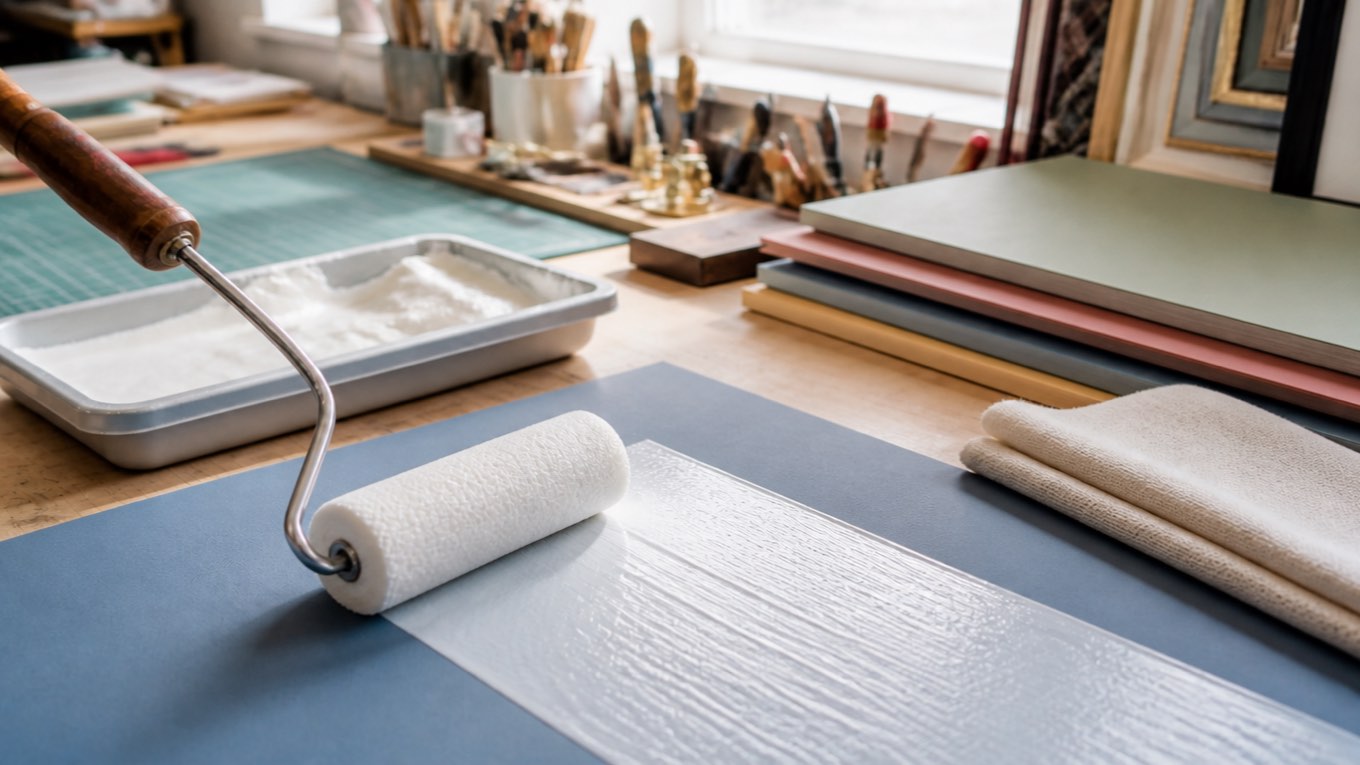
Apply it cold and wet, straight from the jug, with a foam roller sized to the profile or a soft brush. It dries to a tough, permanently flexible film, stays clear, and does not outgas or yellow over time. Once fully cured, it is inert and forms a barrier against acid migration from the substrate into the material being mounted.
The numbers: touch-dry in about ten minutes, full cure at forty-eight hours. Cleanup is warm water while the adhesive is still wet.
Where it does not belong
Miracle Muck is permanent. That is the point of it, and it is also the limit of it: it is not a conservation-quality product, and Raphael’s does not market it as one.
A misconception worth addressing directly: some framers believe that with enough patience, a piece mounted with a permanent wet adhesive can be lifted back off. It cannot. Once the cure is complete the bond is structural, and attempting to separate the layers damages the substrate, the surface, or both.
Conservation work needs a different, reversible mounting method instead, chosen specifically because the mount can be undone cleanly if the piece ever needs to be remounted or treated. If there is any chance a piece will need conservation attention in its lifetime, a permanent adhesive is the wrong tool, whatever else it has going for it.
Matching the adhesive to the job
A permanent wet-mount adhesive covers four jobs, and they account for most of what crosses a bench in a working week.
- 1
Wrapping fabric
Cotton, linen and silk onto liners, mats, foam core and Gatorboard: the job with the most technique in it, where order matters more than pressure.
- 2
Mounting canvas
Canvas and linen to panels and most hardboard. Roll both surfaces and work outward from the centre so trapped air can escape.
- 3
Joining corners and fillets
Where a permanently flexible film is an advantage rather than a compromise: the joint moves with the wood instead of cracking away from it.
- 4
Sizing a canvas
Both sides, before the ground goes on. Coats depend on the ground and on oils versus acrylics, so test a small canvas first.